Reliance for post-authorisation changes pilots

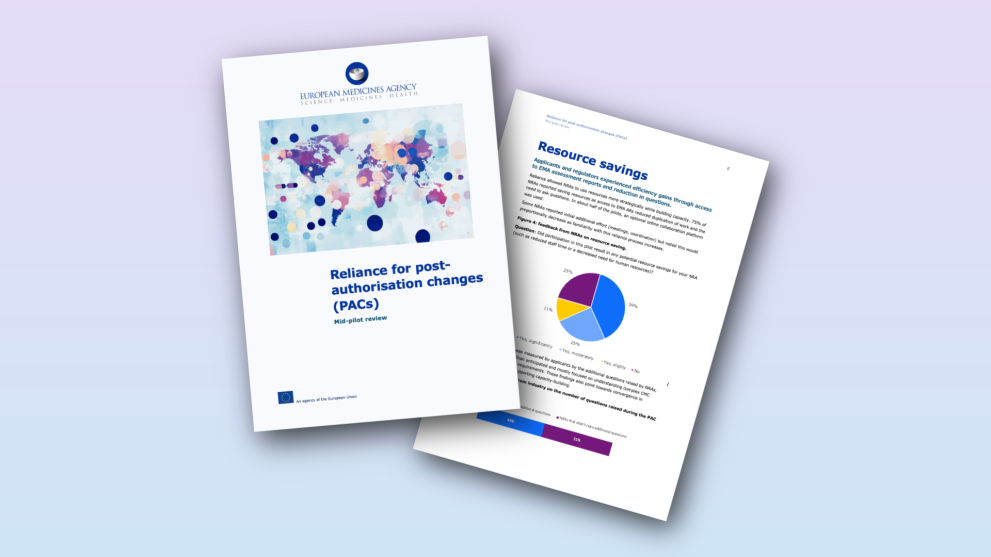
EMA is testing a global model for post-authorisation changes with national regulatory authorities outside the EU, the World Health Organization (WHO) and the pharmaceutical industry. The programme enables authorities to use EMA's assessments to inform national decision-making and facilitate patient access to quality-assured medicines. This approach is based on the principle of reliance.
CorporateMedicines for use outside the EU
Slovak is available via eTranslation, the European Commission's machine translation service.

Translate to Slovak | Important information about machine translation

EMA and WHO are supporting a programme that enables pharmaceutical companies to submit EMA-approved post-authorisation changes (i.e. variations) to multiple non-EU national authorities.

The programme enables national regulatory authorities (NRA) to access EMA's assessments and receive documentation packages through simultaneous submissions.

National authorities keep full scientific and regulatory independence in their decision-making.

Pharmaceutical companies take the initiative to start a pilot.

Most pilots cover major quality-related post-authorisation changes that can impact the supply of medicinal products.

For more information, see:

Pilot objectives

The reliance pilots aim to accelerate review and approval timelines in a concurrent review. This means that multiple regulatory authorities assess a product application simultaneously. They do so by exploring relevant regulatory pathways, in line with WHO's good reliance practices.

They also aim to:

  • facilitate patient access to quality-assured medicines;
  • make better use of resources;
  • help authorities align on regulatory requirements, also referred to as convergence;
  • improve transparency between the pharmaceutical industry and regulatory authorities, and among regulatory authorities.

Regulatory authorities use reliance extensively when they approve medicines. However, they do not apply reliance widely to assess post-authorisation changes. These changes can be complex, time-consuming and unpredictable, which increases the risk of shortages.

Insights and recommendations from these pilots will help achieve a more efficient global model based on standardised reliance practices to assess post-authorisation changes. This will benefit both regulatory authorities and the pharmaceutical industry.

For more information, see:

Preliminary findings on pilots

80%
of post-authorisation changes approved in half the usual time

Comparison with standard national procedures that do not use the principle of reliance

75%
of participating NRAs reported saving resources
77
NRAs participated in one or more pilots

Participation figures as of end of 2025

48
pilots initiated involving more than 100 NRAs

Data covering period until end of July 2026

The pilot programmed marked key achievements, including:

  • Broad international participation
  • Faster approval timelines in comparison with standard non-reliance procedures
  • Lower NRA workload and resource savings
  • High trust in EMA assessment reports - documents provided enough details to support decision-making processes
  • Convergence of submission requirements - surveyed NRAs found it feasible to align country specific requirements to EMA’s documentation requirements
  • Greater predictability, reducing shortage risks

Workshop on early findings and implementation experience

A meeting report is available from a May 2026 workshop which explored:

  • early results of the pilot programme; 
  • its transition into routine practice.

EMA organised the workshop exclusively for national regulatory authorities. Participants discussed early findings of the programme.

In addition, the national authorities of Serbia, Egypt and South Africa shared their own experiences on the practical implementation of the programme.

The full report is available below:

Pilot metrics

There are a few important metrics that applicants should collect to evaluate the performance of a pilot. Find them below:

  • Country engagement - which countries were involved in a pilot, percentage of countries that accepted to participate and reasons for countries not wanting to join a pilot
  • Level of reliance - whether national authorities can recognise EMA's assessment or whether they need additional scientific evaluation
  • Time - how long did national authorities take to approve the post-authorisation changes
  • Level of harmonisation - how many additional changes the applicant made to their dossier to comply with local requirements
  • Potential resources saved - both time and human resources needed to manage the post-authorisation changes submitted

Page update history

An update log is available to show the date and summary of changes to this webpage. It does not include updates to linked documents or minor edits like typos or broken link fixes.

The tracking of updates begins in August 2026.

13 August 2026

Share this page