ESAUvet annual report chicken

Avian influenza (bird flu)

Avian influenza, also known as bird flu, is a viral disease that can be highly pathogenic in birds. While the public health risk of this disease is low, authorities such as the European Medicines Agency (EMA) remain alert.
HumanVeterinary

Updated on 27 January 2026:
'Veterinary medicines' section - to add information about authorised vaccines

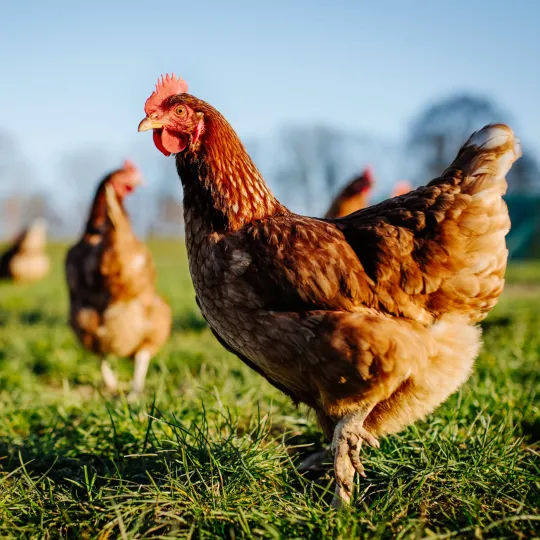
Avian influenza is a highly contagious viral disease that occurs mainly in poultry, such as chickens, ducks and turkeys and wild water birds, such as gulls. It can affect both wild and farmed (domestic) birds. 

Some strains of avian influenza can be highly pathogenic, meaning that infected birds can suffer serious disease or even death. This makes it a serious threat to birds.

Highly pathogenic can also have economic consequences for poultry farmers across the world, including in the European Union (EU). 

Outbreaks of avian influenza have occurred in the EU since the early 2000's. However, 2021 and 2022 saw the highest number of outbreaks of highly pathogenic virus ever recorded in Europe, particularly in farmed poultry. Recent data show high infection rates of highly pathogenic virus in several regions of the world, which have made it necessary to cull an extensive number of farmed birds. 

Certain mutations may allow the virus to spread from mammal to mammal, which makes it of particular concern.

There is no evidence the virus can be transmitted to humans through food, such as contaminated poultry products. However, poultry workers, veterinarians and other people in direct contact with infected birds are at increased risk of infection. 

While the public health risk remains low, authorities such as EMA must be alert to the risk of a potential outbreak affecting humans as well as birds.

For more information about EMA's work on public health threats, see:

EMA's role

EMA is responsible for evaluating potential vaccines to protect birds against the virus, and potential vaccines and treatments for humans

This is in line with EMA's role overseeing the evaluation and supervision of medicines for both humans and animals in the EU. It includes helping prepare for and manage crisis situations affecting the EU, based on legislation that took effect on 1 March 2022. 

In the EU, the European Food Safety Authority (EFSA) is responsible for monitoring data on diseases caused by infections that spread between animals and people (zoonotic diseases). It does so in cooperation with the European Centre for Disease prevention and Control (ECDC) and EU Member States. 

EMA is working closely with EFSA, ECDC, the European Commission, national competent authorities and the World Health Organization (WHO) to monitor and respond to the evolving situation.  

For more information, see: 

Veterinary medicines

As of November 2025, EMA has authorised five veterinary vaccines against the highly pathogenic avian influenza virus, subtype H5. 

More information on these vaccines can be found on the Veterinary Medicines Information website.

Authorised vaccines
Nobilis Influenza H5N2 A conventional, inactivated vaccine, which could potentially help address the risk of highly pathogenic avian influenza, but it is currently produced in limited quantities.
Innovax ND-H5 A vector vaccine for chickens where the vector, a turkey herpesvirus, expresses the fusion protein gene of the Newcastle disease virus and the haemagglutinin gene of the avian influenza virus subtype H5.
Vectormune HVT-AIV A vector vaccine for chickens where the vector, a turkey herpesvirus, expresses the haemagglutinin gene of avian influenza subtype H5. It is intended for the active immunisation of one-day-old chicks to reduce mortality, clinical signs and virus excretion due to infection.
Vaxxitek HVT+IBD+H5 A vector vaccine for chickens, embryonated chicken eggs and turkeys where the vector, a turkey herpesvirus, expresses the VP2 protein gene of the infectious bursal disease virus and the haemagglutinin gene of avian influenza virus subtype H5.
Vaxxinact H5 A biotech vaccine containing avian influenza virus, subtype H5, haemagglutinin (recombinant) for the active immunisation of chickens, ducks and turkeys to prevent or reduce mortality, clinical signs, and viral excretion due to infection.

Avian influenza vaccine strategies

Farmed poultry are not routinely vaccinated against avian influenza in the EU. But EFSA has provided a scientific opinion on possible vaccination and monitoring strategies in Europe, following a request from the European Commission.

Vaccination against highly pathogenic avian influenza is common in some regions outside the EU. Several vaccines are thus available, although not currently authorised in the EU. 

EMA ran a survey in February 2023 to gather relevant information on these vaccines and offered to discuss EU authorisation with their manufacturers.

For more information see:

Human medicines

EMA is in dialogue with medicine developers to gain an overview of available data on:

  • suitability of existing and potential new vaccines and treatments;
  • opportunities to adapt existing vaccines to match more closely the virus strains in circulation

This is part of EMA's role in preparing for and responding to public health threats. EMA's Emergency Task Force (ETF) is reviewing all the available information. 

If necessary, EMA can trigger its plan for public health threats. It guides how EMA operates during an emerging health threat. In such a scenario, increased speed, efficiency and coordination among public health authorities are critical. 

The plan enables fast-track approval of vaccines and antivirals to prevent or treat a disease caused by an emerging virus. It also allows EMA to mobilise and concentrate scientific resources across the European medicines regulatory network in response to a threat.

For more information on EMA's health threats plan, see:

Authorised vaccines 

Three vaccines are authorised for use in the EU during avian influenza outbreaks without there being a declared pandemic. They are meant to protect poultry workers, veterinarians and other people at increased risk of exposure. They might need adapting to match more closely the current virus strains: 

Authorised vaccines
Aflunov A vaccine used in adults and children above the age of 6 months to protect against flu caused by the H5N1 (‘bird flu’) strain of the influenza A virus.
Celldemic A vaccine used to protect adults and children from 6 months of age against influenza (flu) caused by the H5N1 subtype of the influenza A virus.
Zoonotic Influenza Vaccine Seqirus A vaccine used in adults to protect against flu caused by H5 strains of the influenza A virus. 

Pandemic preparedness influenza vaccines

There are four pandemic preparedness influenza vaccines authorised in the EU that can be rapidly modified to protect people in a pandemic situation.

These were authorised based on immunogenicity data. They can be adapted to protect against any pandemic influenza virus strain if necessary.

They are only for use if the WHO or the EU were to officially declare a pandemic, which has not happened.

Authorised pandemic preparedness influenza vaccines
Pandemic influenza vaccine H5N1 AstraZeneca (previously Pandemic influenza vaccine H5N1 Medimmune) A vaccine developed to protect children aged between 12 months and 18 years against influenza (flu) during a flu pandemic.
Adjupanrix (previously Pandemic influenza vaccine (H5N1) (split virion, inactivated, adjuvanted) GlaxoSmithKline Biologicals) A vaccine that is given by injection. It contains parts of influenza (flu) viruses that have been inactivated (killed). 
Foclivia Foclivia is a vaccine used in adults to protect against flu when a ‘pandemic’ has been officially declared by the World Health Organization (WHO) or the European Union (EU). 
Incellipan  A pandemic preparedness vaccine used to protect adults and children against influenza (flu). It can only be used during a pandemic declared officially by the World Health Organization (WHO) or within the European Union (EU).

EMA played a key role in the authorisation of medicines and vaccines for use during the Coronavirus disease (COVID-19) pandemic and the 2009 (H1N1) influenza pandemic.

Antiviral medicines

Certain antiviral medicines are also authorised for use in the EU to treat influenza:

Authorised antiviral medicines
Dectova Dectova is an antiviral medicine used to treat complicated and potentially life-threatening influenza (flu) caused by either the influenza A or B virus in adults and children from 6 months of age. 
Ebilfumin Ebilfumin is an antiviral medicine that contains the active substance oseltamivir. It is used to treat or prevent influenza.
Tamiflu Tamiflu is an antiviral medicine used to treat or prevent influenza.
Xofluza Xofluza is an antiviral medicine for treating and preventing flu in adults and children from 1 year of age.

Share this page