
Meeting highlights from the Committee for Medicinal Products for Human Use (CHMP) 18-21 May 2026
Eight new medicines recommended for approval; another 13 medicines recommended for extension of their therapeutic indications
NewsHumanMedicines
EMA’s human medicines committee (CHMP) recommended eight medicines for approval at its May 2026 meeting.
Jascayd (nerandomilast) received a positive opinion from the CHMP for the treatment of idiopathic pulmonary fibrosis (IPF) or progressive pulmonary fibrosis (PPF), two serious lung diseases that involve progressive and irreversible scarring (fibrosis) of the lung tissue. There are limited treatment options for people suffering from IPF or PPF. Both conditions can cause severe symptoms, including difficulty breathing, leading to hospitalisation and ultimately death within a few years of diagnosis due to a progressive decline in lung function. See more details in the news announcement in the grid below.
The CHMP recommended granting a conditional marketing authorisation for Vijoice (alpelisib), for the treatment of patients with severe PIK3CA-related overgrowth spectrum (PROS) disorders. PROS is a diverse group of rare genetic conditions that are characterised by uncontrolled growth of some tissues in the body, causing malformations and tumours affecting the skin, bones, blood vessels and brain. There is currently no authorised medicine for PROS and treatment consists of supportive care, including surgery and procedures to block overgrown blood vessels. See more details in the news announcement in the grid below.
The committee recommended granting a marketing authorisation for Boey (trenibotulinumtoxinE), for the temporary improvement in the appearance of moderate to severe lines between the eyebrows when these have an important psychological impact in adults.
The CHMP adopted a positive opinion for Etcamah (camizestrant), for the treatment of adults with locally advanced or metastatic breast cancer with a specific mutation in the ESR1 gene.
The CHMP recommended granting a marketing authorisation for three hybrid applications, which rely in part on the results of pre-clinical tests and clinical trials of an already authorised reference product and in part on new data:
A biosimilar medicine, Vislyfa (ranibizumab), received a positive opinion for the treatment of several eye diseases causing vision impairment.
The committee recommended not granting a marketing authorisation for Deqtynet (copper (64Cu) oxodotreotide), a diagnostic medicine intended for use with positron emission tomography (PET) imaging to detect well-differentiated neuroendocrine tumours (NETs) in adults. Neuroendocrine tumours are rare tumours that can develop in different parts of the body, such as the pancreas, intestines or lungs. Well-differentiated means that the cells look and behave like normal cells and grow slowly.
For more information on this negative opinion, see the question-and-answer document in the grid below.
The committee recommended extensions of indication for 14 medicines that are already authorised in the European Union (EU):
Braftovi, Enhertu, Erbitux, Fasenra, Hetronifly, Iclusig, Keytruda, Maviret, Padcev, Palynziq, Sogroya, Tepkinly and Trodelvy.
Applications for initial marketing authorisation for two medicines were withdrawn:
Question-and-answer documents on the withdrawal of these two applications are available in the grid below.
The CHMP has recommended an extension to the marketing authorisation for Wegovy (semaglutide) for weight management to add a daily oral tablet as alternative formulation to weekly subcutaneous injections. Wegovy tablets can be used, together with diet and physical activity, in adults with obesity, or in those who are overweight and have at least one weight-related comorbidity. This is the first glucagon-like peptide (GLP-1) receptor agonist for weight management developed for oral use.
See more details in the news announcement in the grid below.
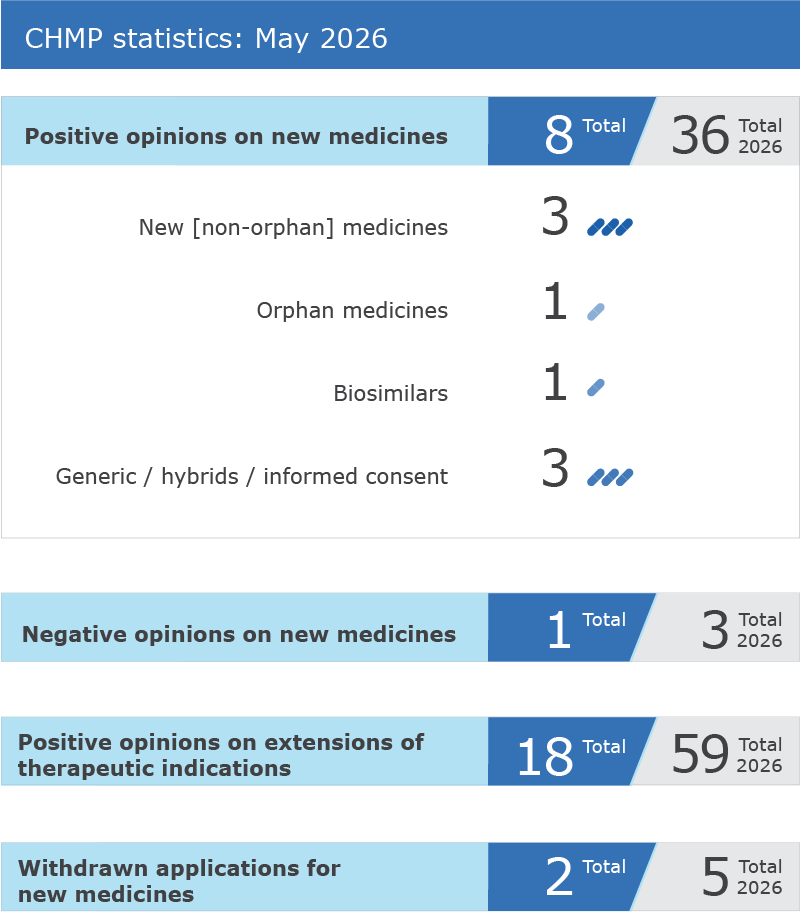
Key figures from the May 2026 CHMP meeting are represented in the graphic below.
May 2026 statistics - monthly and cumulative figures for CHMP opinions and withdrawn applications:
8 positive opinions on new medicines: 3 new non-orphan medicine, 1 orphan medicines, 1 biosimilar and 3 generic, hybrid or informed consent medicine. Total in 2026: 36
1 negative opinions on new medicines. Total in 2026: 3
18 positive opinions on extensions of therapeutic indication. Total in 2026: 59
2 withdrawn applications for new medicines. Total in 2026: 5
trenibotulinumtoxinE
AbbVie Deutschland GmbH & Co
Temporary improvement in the appearance of moderate to severe lines between the eyebrows when these have an important psychological impact in adult patients
camizestrant
Astra Zeneca
Etcamah in combination with a CDK4/6 inhibitor (palbociclib, ribociclib, or abemaciclib) is indicated for the treatment of adult patients with ER-positive, HER2-negative, locally advanced or metastatic breast cancer upon detection of ESR1‑mutation and without disease progression during first-line endocrine therapy in combination with a CDK4/6 inhibitor (for biomarker based patient-selection, see section 4.2 and 5.1)
nerandomilast
Boehringer Ingelheim International GmbH
Treatment of adult patients with Idiopathic Pulmonary Fibrosis (IPF) and adult patients with Progressive Pulmonary Fibrosis (PPF)
alpelisib
Novartis Europharm Limited
Vijoice is indicated for the treatment of adult and paediatric patients aged 2 years and older with severe or life-threatening manifestations of PIK3CA-related overgrowth spectrum (PROS) who require systemic therapy
This medicine was designated an orphan medicine
liraglutide
STADA Arzneimittel AG
Treatment of diabetes and weight management
liraglutide
STADA Arzneimittel AG
Treatment of adults, adolescents and children aged 10 years and above with insufficiently controlled type 2 diabetes as an adjunct to diet and exercise
colchicine
Agepha Pharma s.r.o.
Indicated to reduce the risk of myocardial infarction (MI), stroke, coronary revascularization, and cardiovascular death in patients with atherosclerotic disease or with multiple risk factors for cardiovascular disease
ranibizumab
Lupin Europe GmbH
The treatment of neovascular (wet) age-related macular degeneration (AMD); The treatment of visual impairment due to diabetic macular oedema (DME) - The treatment of proliferative diabetic retinopathy (PDR); The treatment of visual impairment due to macular oedema secondary to retinal vein occlusion (branch RVO or central RVO); The treatment of visual impairment due to choroidal neovascularisation (CNV)
copper (64Cu) oxodotreotide
Cis Bio International
For positron emission tomography (PET) imaging of somatostatin receptor overexpression in adult patients with confirmed or suspected well-differentiated neuroendocrine tumours (NETs) excluding neuroblastomas
This medicine was designated an orphan medicine.
encorafenib
Pierre Fabre Medicament
trastuzumab deruxtecan
Daiichi Sankyo Europe GmbH
cetuximab
Merck Europe B.V.
benralizumab
AstraZeneca AB
serplulimab
Accord Healthcare S.L.U.
ponatinib
Incyte Biosciences Distribution B.V.
pembrolizumab
Merck Sharp & Dohme B.V.
glecaprevir / pibrentasvir
AbbVie Deutschland GmbH & Co. KG
enfortumab vedotin
Astellas Pharma Europe B.V.
pegvaliase
BioMarin International Limited
somapacitan
Novo Nordisk A/S
epcoritamab
AbbVie Deutschland GmbH & Co. KG
sacituzumab govitecan
Gilead Sciences Ireland Unlimited Company
infliximab
Celltrion Healthcare Hungary Kft.
bevacizumab
Laboratoires Delbert
semaglutide
Novo Nordisk A/S