Image showing pills and a magnifying glass

Meeting highlights from the Pharmacovigilance Risk Assessment Committee (PRAC) 7-10 April 2026

PRAC agrees on communication to healthcare professionals about cases of severe liver injury with epilepsy medicine
NewsHumanPharmacovigilance
New safety information for healthcare professionals 

Ontozry (cenobamate): new requirements for liver monitoring due to reports of severe liver injury

PRAC agreed on a direct healthcare professional communication (DHPC) to inform healthcare professionals that cases of severe liver injury with hepatic failure have been reported in patients treated with the medicine Ontozry. Most cases occurred when the medicine was used alongside other anti-seizure medications.

Prescribers are recommended to conduct liver function tests before starting treatment with Ontozry and throughout treatment.

They should carry out a prompt clinical evaluation and liver function tests in patients who have symptoms indicating liver injury, such as fatigue, anorexia, right upper abdominal discomfort, dark urine, or jaundice.

Patients should be advised to immediately seek medical attention if they experience signs or symptoms suggesting liver injury.

If liver injury is suspected or detected, dose reduction or discontinuation of Ontozry should be considered, in line with the guidelines of the summary of product characteristics (i.e., unless required, avoid abrupt discontinuation to minimise the risk of rebound seizures).

Increased liver enzyme levels are already listed in Ontozry’s product information as a common side effect (which may occur in up to 1 in 10 people).

Following its review of the cases, PRAC recommended adding liver injury as a rare side effect (which may occur in up to 1 in 1,000 people) to Ontozry’s product information and including warnings for patients and healthcare professionals.

Ontozry is a medicine for treating epileptic seizures starting in one specific part of the brain (focal seizures), including those that eventually spread to the whole brain (secondary generalisation). It is used as an add-on to other epilepsy medicines for adults with seizures that are not controlled despite having tried at least two other treatments.

The DHPC for Ontozry will be forwarded to EMA’s human medicines committee (CHMP). Once adopted, it will be disseminated to healthcare professionals by the marketing authorisation holder according to an agreed communication plan and published on the Direct healthcare professional communications page and in national registers in EU Member States. 

Agenda

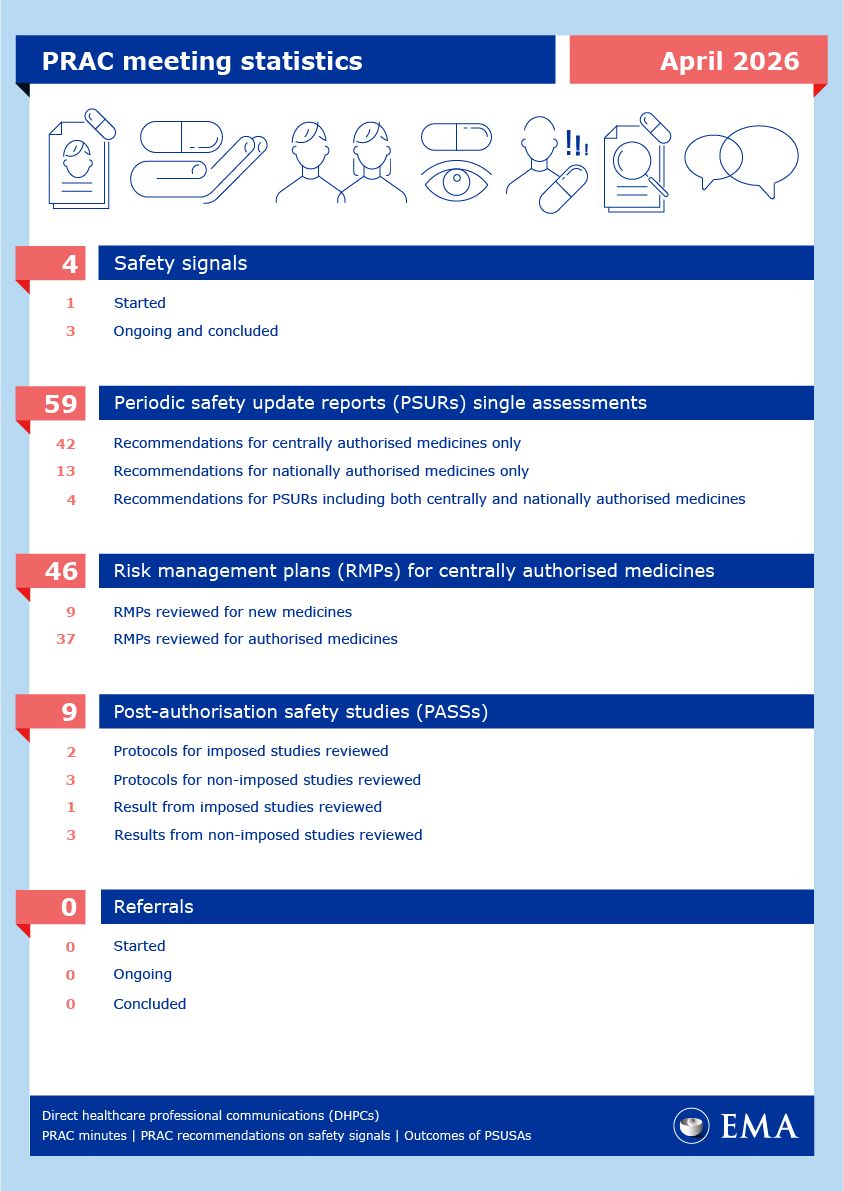
PRAC statistics: April 2026

PRAC statistics April 2026

Glossary

  • Safety signal assessments. A safety signal is information which suggests a new potentially causal association, or a new aspect of a known association between a medicine and an adverse event that warrants further investigation. Safety signals are generated from several sources such as spontaneous reports, clinical studies and the scientific literature. More information can be found under 'Signal management'.
  • Periodic safety update reports, abbreviated as PSURs, are reports prepared by the marketing authorisation holder to describe the worldwide safety experience with a medicine in a defined period after its authorisation. PSURs for medicinal products that contain the same active substance or the same combination of active substances but have different marketing authorisations and are authorised in different EU Member States, are jointly assessed in a single assessment procedure. More information can be found under 'Periodic safety update reports: questions and answers'.
  • Risk management plans, abbreviated as RMPs, are detailed descriptions of the activities and interventions designed to identify, characterise, prevent or minimise risks relating to medicines. Companies are required to submit an RMP to EMA when applying for a marketing authorisation. RMPs are continually updated throughout the lifetime of the medicine as new information becomes available. More information is available under 'Risk-management plans'.
  • Post-authorisation safety studies, abbreviated as PASSs, are studies carried out after a medicine has been authorised to obtain further information on its safety, or to measure the effectiveness of risk-management measures. The PRAC assesses the protocols (aspects related to the organisation of a study) and the results of PASSs. More information can be found under 'Post-authorisation safety studies'.
  • Referrals are procedures used to resolve issues such as concerns over the safety or benefit-risk balance of a medicine or a class of medicines. In a referral related to safety of medicines, the PRAC is requested by a Member State or the European Commission to conduct a scientific assessment of a particular medicine or class of medicines on behalf of the EU. More information can be found under referral procedures.

Share this page